
And Another Scary ‘Outbreak’!
What Is Really Going On?

There have been a number of reports over the course of the past few days that refer to an ‘outbreak’ of meningitis in England. Or, to be more precise, an ‘outbreak’ that is reported to have occurred in Kent, which is a county in the south east of England.
I must emphasise at the outset that I am NOT denying people’s lived experiences when I question mainstream narratives that make positive claims about the causes of illness and even death, as I will be doing in this article. I am also not insensitive to the tragic loss of two young lives!
The very real experience of illness and death is an entirely separate issue from a discussion about the causes of illness and death. Please bear this in mind as we dive into this topic.
A 15th March BBC article Uni student among two dead in Kent meningitis outbreak, makes the claim that,
“Meningitis is an infection of the protective membranes that surround the brain and spinal cord and can be serious if not treated urgently.”
This is misleading because the suffix -itis means inflammation, not infection. Meningitis means inflammation of the meninges. Nevertheless, it’s claimed that meningitis can be caused by a variety of ‘germs’, as in the April 2025 WHO Menigitis fact sheet,
“Many organisms can cause meningitis, including bacteria, viruses, fungi and parasites.”
So much for the theory that one germ causes one disease!!!
The BBC article includes a list of the symptoms,
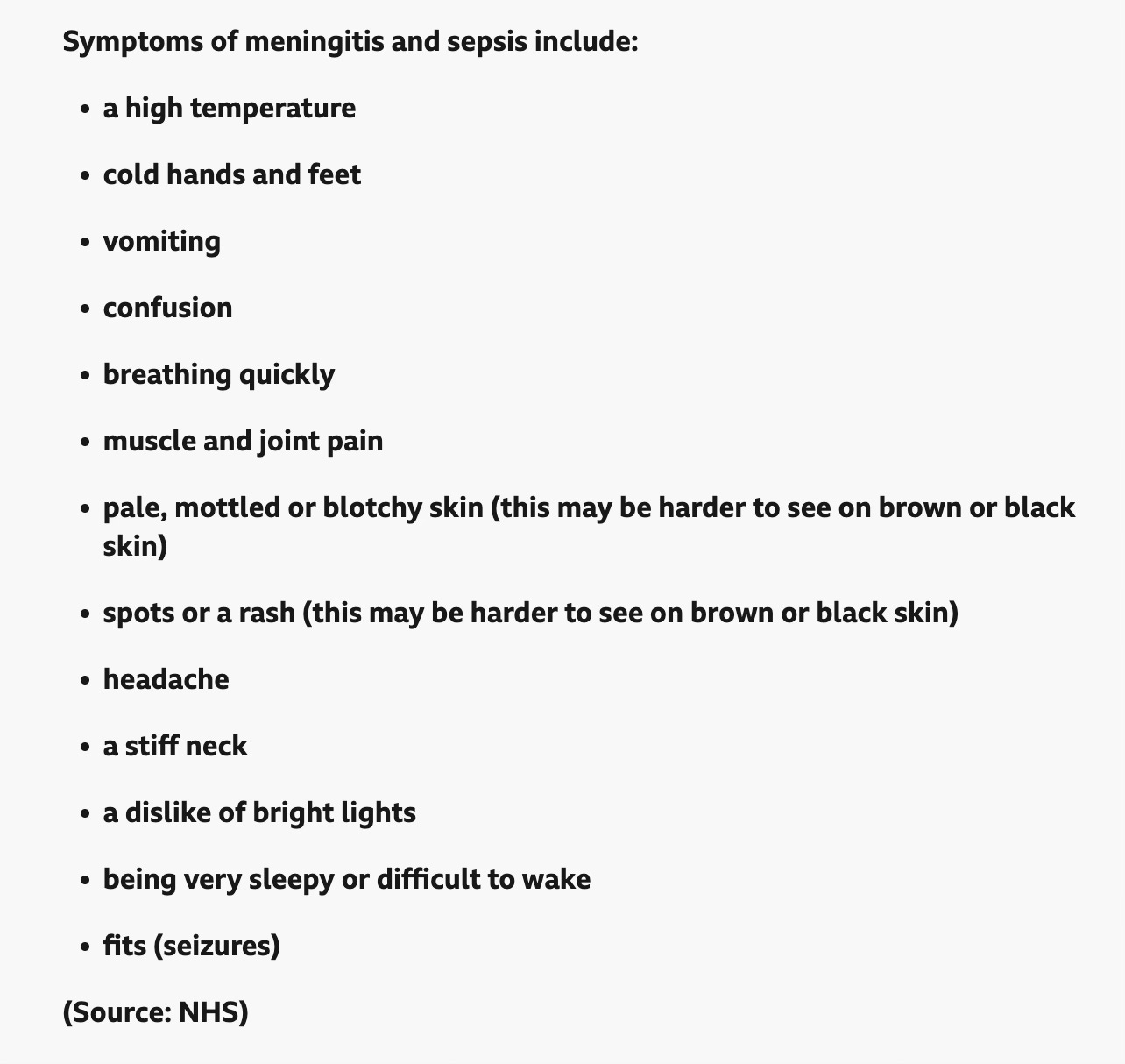
Sepsis is also known as ‘blood poisoning’, which is a more accurate description than ‘infection’. The reason for including the symptoms of sepsis, which is not the same condition as meningitis, is explained in a 16th March BBC article, What are the symptoms of meningitis and is there a vaccine?
“Bacterial meningitis is rarer but more serious than viral meningitis. It can lead to blood poisoning or sepsis, and can affect the brain.”
Initially, there was some uncertainty about the ‘strain’ of meningitis affecting the young people in Kent, but by 16th March, this was claimed to have been identified, as the article states,
“The specific strain of meningitis behind the Kent outbreak has been identified as type B disease (MenB), which is behind most cases of meningococcal disease in the UK.”
It would seem that this condition has an affinity for the young, as the 15th March BBC article claims,
“Meningitis can affect anyone but is most common in babies, young children, teenagers and young adults.”
No reason is offered for this situation, although the article makes a suggestion for the idea that there is a ‘greater risk’ for teenagers and young adults, especially students,
“University students and young adults are among the groups at increased risk because meningitis bacteria can spread more easily in settings where people live, study and socialise closely together.”
But this does NOT explain the initial source.
Furthermore, if this were the case, why aren’t all Universities affected? The Kent University is not unique with respect to the situation of its students living, studying and socialising closely together.
Or maybe that is part of the narrative - to make all students at all Universities afraid.
I know students elsewhere are already being affected by the story, because I’ve been contacted by a friend whose son has shown concern, even though he is at University in a very different part of the country.
The situation in Kent was considered to be of such importance that the BBC provided a ‘Live update’ page on their website on 17th March, which included in its reporting that,
“NHS Kent and Medway says it is giving free antibiotics to people who visited a Canterbury nightclub on three particular days in March.
It says that more emergency antibiotics are available for “people who visited Club Chemistry on March 5, 6 and 7”.
We’ll return to ‘Club Chemistry’ shortly.
Unsurprisingly, the issue of vaccination is discussed in a BBC article dated 17th March Why is MenB vaccine not given to teenagers in UK and should they be offered it? that states,
“Babies are routinely offered a vaccine against MenB, and have been since 2015, but the UK’s current generation of older teenagers and university students have not, since the shot was not available when they were born.”
When the MenB vaccine was introduced in 2015, it was decided to only offer it to babies and young children and not to extend it to teenagers, as the article states,
“The UK decided against running a catch-up campaign to vaccinate teenagers, but some parents have been buying the jab privately.”
However, this decision has resulted in some controversy because of the current ‘outbreak’,
“Former health minister Helen Whatley, Conservative MP for Faversham and Mid Kent, said the government should consider a MenB “catch-up” vaccination campaign for young people.”
This suggestion has been implemented and a ‘targeted vaccination programme’ has been rolled out for certain people in the Kent area, as discussed in an 18th March BBC article, People don’t need to buy a meningitis vaccine, Streeting says, which states,
“A targeted vaccination programme has begun for students in halls of residence at the University of Kent, in Canterbury, where the outbreak has occurred, with antibiotics also being distributed.”
Yet in the 17th March article it was stated that the case for vaccinating teenagers is ‘complicated’ and that,
“While the vaccine is great at protecting infants, it does not work so well in young people.”
An effort to explain this is offered by the BBC article,
“Professor Sir Andrew Pollard, an immunologist at Oxford University, told the BBC: “The B strain is more complicated because although we call it the B strain, it’s actually a collection of a very large number of different strains, some of which are covered by the B vaccine and some aren’t.”
This does NOT explain why the vaccine is allegedly ‘effective’ for babies and young children, but not as effective for teenagers.
This situation raises many questions: Why would this be the case? If a vaccine is effective, surely it would be effective for everyone? How does the ‘germ theory’ account for such a difference?
And, in line with the change of policy to vaccinate students in Kent, we need to also ask: Why have they changed their minds about vaccinating students if it doesn’t work so well for them?
Another question that needs to be raised is: How can meningitis be so dangerous when ‘some people’ can be infected but have no symptoms? In other words, the utterly ridiculous concept of ‘asymptomatic carriers’ can also apply to meningitis, as the 17th March BBC article states,
“Some people carry the various types of meningitis B bacteria harmlessly in their nose and throat. They don’t get sick, but can spread it to others who may.”
But if there are no symptoms, despite the presence of ‘germs’, then how can the ‘germs’ be the cause of disease?
Answer: They can’t.
The situation is receiving greater attention in the media in increasingly disturbing terms, such as the 18th March BBC article the headline of which claims Health bosses can’t confirm meningitis outbreak contained.
So, what is going on here?
The facts are that 2 young people have sadly died and a number of teenagers, mainly University students have been or are still ill.
The medical authorities claim to ‘know’ the health problem is meningitis due to ‘tests’ they have carried out. These tests are claimed to have ‘shown’ that the ‘strain’ of meningitis is MenB, which is said to mean that it is caused by ‘meningococcal group B bacteria’, as shown by the NHS web page, MenB vaccine for children,
“The MenB vaccine helps protect against meningococcal group B bacteria that can cause serious illnesses, including meningitis and sepsis. It’s given to children when they’re 8 weeks, 12 weeks and 1 year old.”
BUT - there is no evidence that any bacterium is the cause of any disease.
As stated above, the presence of these bacteria is not always accompanied by illness, as the WHO fact sheet also states,
“Carriage of these organisms is usually harmless and contributes to building up immunity against infection, but the bacteria occasionally invade the body, causing meningitis, sepsis and other forms of invasive disease.”
The terrain paradigm explains that bacteria perform different functions within the body that are mainly those involving the elimination of dead and dying tissues. They are therefore helpers, not agents of disease.
This naturally leaves us asking: So why are the students ill?
The answer to that question is difficult to discover because there will always be multiple factors involved, including exposures to ‘toxins’ of some description.
Unfortunately, the vaccines are only going to make the situation worse for those students. No vaccine has ever been proven to prevent any disease. But they can certainly contribute to ill-health, as can be seen by their ingredients, which can be found in the following vaccine information PDF, a section of which is in the screenshot below.
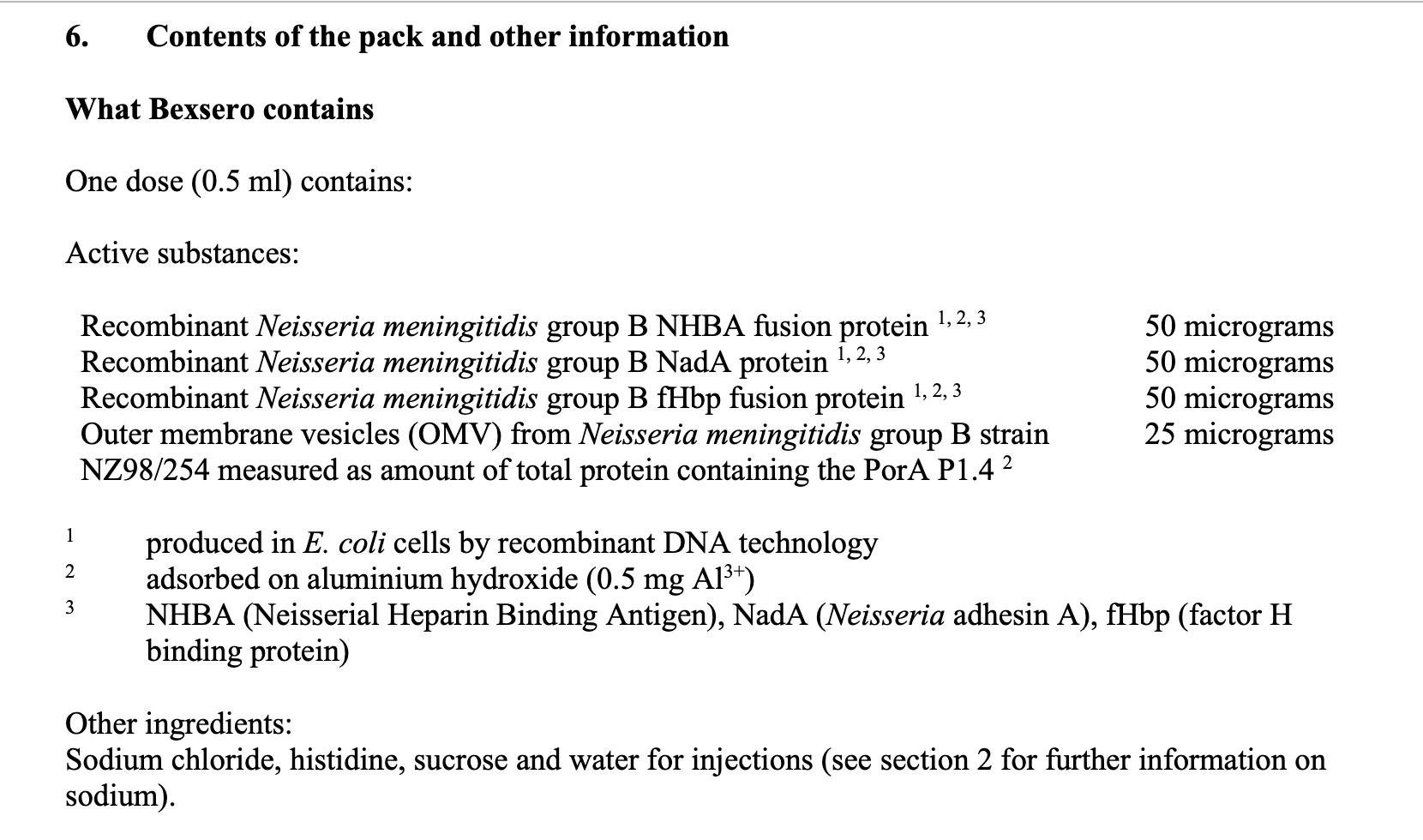
Although most people will be concerned about the ‘germs’ that have been included as ingredients of the vaccines, my focus and concern lie with the fact that they are produced with ‘recombinant DNA technology’.
Whilst my research has shown that DNA is not our ‘blueprint’ - more on that in future articles - of concern is the fact that scientists, and those who work in the research departments of vaccine manufacturers in particular, are happy to use these technologies in products that are to be injected into tiny babies at the ages of 8 and 12 weeks then again at 1 year.
Where are the long-term clinical trials for these vaccines to test whether such products are truly ‘safe’? And that’s ignoring the existence of any tests that determine whether they are effective - which they are not.
Back to the question of possible causal factors. We cannot make any positive claims about ‘causes’ because we do not know what they are. We do not have the appropriate information about all of the substances to which the students may have been exposed.
One of the first steps of the medical system was to offer students antibiotics, which by their very nature are toxic; their purpose is to kill bacteria. However, antibiotics can have an anti-inflammatory effect, which would make it seem as if the ‘problem’ - inflammation - has been solved, but that will almost certainly not be the case, even if there may be temporary relief from the symptoms.
The function of bacteria is to help clear damaged tissue. But there will have been an underlying cause of that damage, which will be the reason the tissue has become inflamed. It is therefore the cause of that underlying damage that needs to be investigated for each person because each of us is a unique individual. However, there may be some common factors when people in the same environment experience a similar inflammatory response at the same time.
One of the possible causes are certain types of drugs, such as NSAIDS for example. One question to ask would be: Were any of the students taking any of those sorts of drugs?
What about stress, which is widely known to cause a variety of health issues - and Uni students are certainly under a great deal of stress, so it would not be at all surprising that many of them have been affected in this way.
What is also known is that certain toxic substances have been shown to affect the brain and nervous system, as shown on the Beyond Pesticides web page entitled Pesticide-Induced Diseases: Brain and Nervous System Disorders
One question to ask may be: Had any pesticides been used on the campus or in the vicinity of the campus?
Glyphosate in particular is mentioned in a study article entitled Aseptic meningitis in association with glyphosate-surfactant herbicide poisoning. In the Conclusion of the Abstract to this paper is the statement that,
“CNS signs and symptoms induced by aseptic meningitis should be considered in cases of glyphosate-surfactant herbicide poisoning.”
One aspect that does not seem to have been investigated is what substances the students may have been exposed to at Club Chemistry - and I don’t mean the staff member who is alleged to have ‘meningitis’. These would include chemicals applied to the environment within the vicinity of the Club or chemicals used within the Club for cleaning purposes perhaps. Sadly, it is highly unlikely that these aspects will be considered whilst everyone is looking for ‘germs’ to blame.
Another aspect to consider is the overall agenda, especially the goals of the 2030 Agenda, one aspect of which is a June 2021 document entitled Defeating meningitis by 2030: a global road map
Under the heading Overview, that web page states,
“The vision of the Defeating meningitis by 2030 global road map is “Towards a world free of meningitis” carried by three visionary goals: i) elimination of bacterial meningitis epidemics, ii) reduction of cases of vaccine-preventable bacterial meningitis by 50% and deaths by 70%, and iii) reduction of disability and improvement of quality of life after meningitis.”
So, would this alleged ‘outbreak’ be useful to this agenda?
I’d say the answer is yes. Especially with respect to ‘vaccine-preventable bacterial meningitis’ - except that there is no evidence that meningitis is caused by bacteria, nor is there any evidence that vaccines can prevent it.
It’s also important to draw attention to the somewhat related phenomena of ‘mass psychogenic illness’ and the ‘nocebo effect’, both of which demonstrate i) how fear can be spread and ii) how that fear can even lead to the manifestation of symptoms.
Again, I’m not denying the reality of symptoms, but I am emphasising the importance of being discerning about such ‘news stories’, especially those that refer to any form of ‘infectious’ or ‘contagious’ diseases - because no ‘germ’ has ever ben proven to be the cause of any disease.
Dawn 🌹
My work remains free thanks to the kind support of paid subscribers and generous donations for coffees and/or books. [My preference is for the latter 😊]
Resources:
https://drsambailey.com/resources/videos/germ-theory/the-meningitis-mystery/
Other Useful Resources:
If you are looking for ways to start or continue your journey of taking responsibility for your own health, below are some useful resources:
New Biology Clinic
“At New Biology Clinic, we prioritize your individual well-being with personalized holistic care rooted in the proven natural healing principles of the New Biology.”
Use code dawn18 for a discount on your activation fee
The Way Forward
“Within our private community, we provide a platform to connect with nearby natural health practitioners and like-minded members, join monthly virtual events, and receive deeper education on a journey towards health, freedom, and coherence.”
Link for details & to join the TWF community
Alfa Vedic
“Formulated by a physician with over four decades of clinical expertise, Alfa Vedic combines modern research and spagyric alchemy to activate energy, strengthen resilience, and elevate your health.”
Undo Meditation
“Matthew’s approach is ideal for those ready for genuine transformation who have grown weary of conventional therapies or quick-fix solutions. If you’re eager to develop a deeper understanding of yourself and implement lasting change in both your personal and professional life, Matthew is your next step.”
N.B. Use code DAWNL1 for one free month when you purchase a monthly subscription.
They are trying to jump start another fake pandemic. All the modern stone age medical mafia has in its toolbox is the fear hammer and the screw-us driver.
Excellent smorgasbord of actual scientific possibilities! Let's not forget the myriad of pharma poisons that the unfortunate victims could already have taken. B12 jabs, skinny jabs, HPV... esp the students.